It depends on the couple. Obviously.
Here’s my situation, and what worked, and what didn’t.
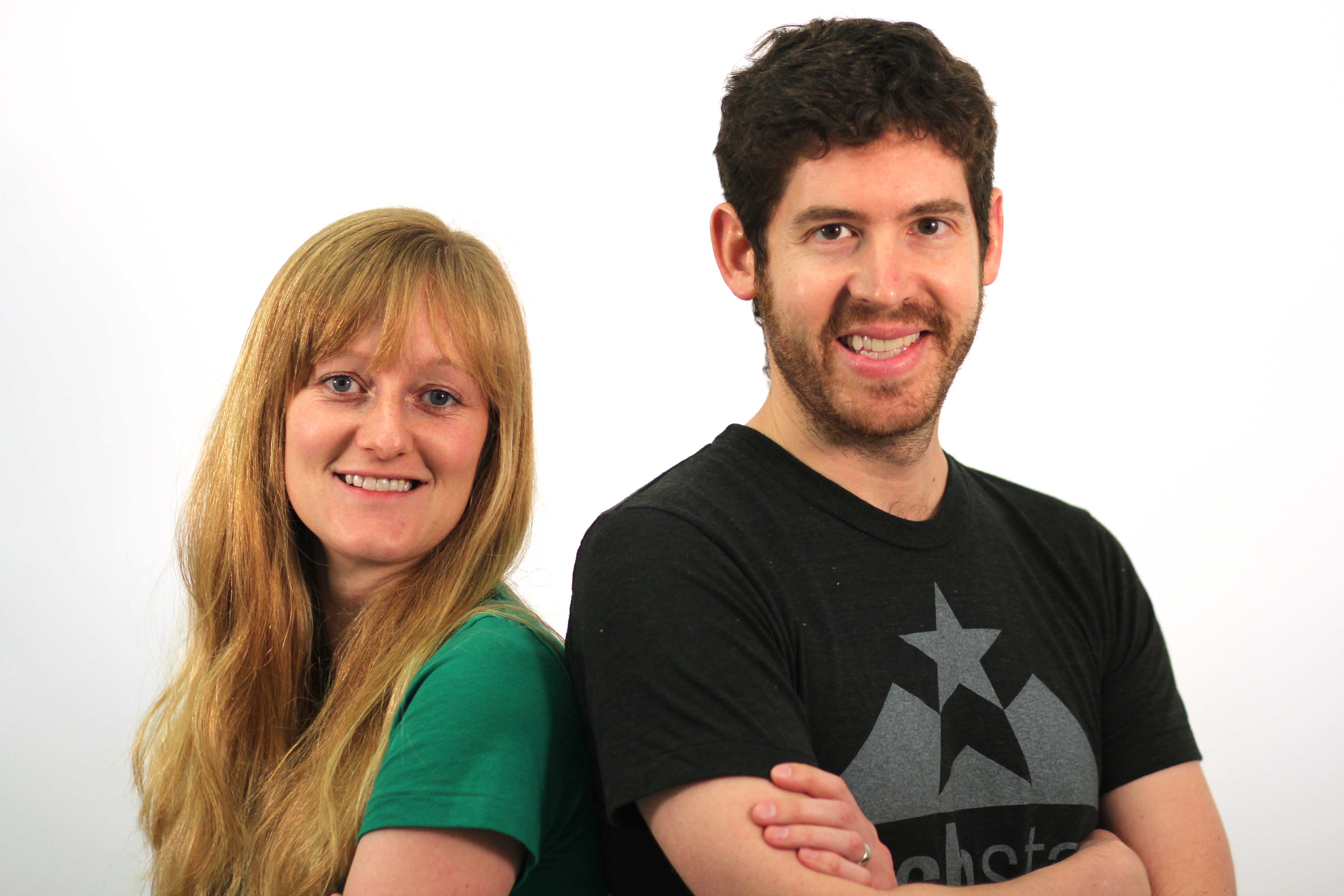
My husband, Tom, joined me as a cofounder after I had been working on Omakase for nearly a year. I was accepted to Techstars as a single founder and travelled to NYC alone, but Tom joined me about halfway through the program. At Omakase, he was merely helping out, although he put in as many hours as I did. The company wasn’t his passion, but Tom’s the type of person who likes to solve problems and help out where he can, so he dove in.
I reached a point toward the end of Techstars where everything started to fall apart, and I really wanted to quit. Tom looked at the company’s recurring donation revenue, and he said, “Look, this is still a lot of money every month that could be going somewhere great. Everyone loved it last month when you bought a bunch of laptops for the charity that taught kids to code (Omakase picked a different charity to donate to each month). You should just narrow your scope and focus on that.”
Tom said he thought the laptops-for-kids approach was really powerful and was something that he could get on board with as a cofounder. I was sold.
We talked and planned and schemed all night over beers at a pub near my tiny studio in Greenwich Village and then showed up the next morning at the Techstars office with an entirely new pitch and new company. We renamed the company Codestarter and built the new website in a week (thanks to our ridiculously awesome team), launching officially on Demo Day.
Tom and I worked together as cofounders for 14 months. Every couple brings different skills and backgrounds to the work table. Tom’s and my situation can’t be neatly applied to anyone else’s. But here’s the gist of what work, what didn’t, and what I’d recommend to anyone considering working with their spouse.
Trust.
Picking your cofounder is like picking a spouse. Whether things go poorly or super well, you better trust that person not to screw you over. After more than fifteen years together, I was certain Tom would never make a business decision that would reflect negatively on me.
Working with my husband also meant that I knew my cofounder inside and out. I felt comfortable asking him uncomfortable questions, and I could read the thinking behind his answers. I knew when he needed me to hold back and give him space, and when it was a good time to throw a stack of new ideas or concerns his way. Trust is the greatest benefit of working with a spouse, a close family member, or a life-long friend.
How to handle the work/personal life balance.
I can’t speak for Tom, but here’s what I did: I rarely mentioned Codestarter at home. Aside from the nonstop 3-month, crazy of Techstars, at the end of the day, I left work at the office. Even when I was really stressing out, I kept it to myself and made our home life about our son, our friends and family, and our life beyond Codestarter. I compartmentalized. Come Monday morning, in the office, I’d resume conversation.
Tom and I have both had work in the past that consumed every part of our lives, and I think we each decided that we didn’t want to run Codestarter that way. We used several services, like Intercom and Slack, to help ensure that we would be aware of any critical happenings outside of normal business hours. Occasionally there were times when I took phone calls at night with a Partner Organization, or Tom needed to set up 25 missional-critical laptops in one long night, but mostly we kept business in the office, which allowed us to focus on family and friends at home.
Are your employees uncomfortable?
Imagine having a boss who is so in love with his or her own idea that they jump up and down and are positive it’s the best thing since Instagram and there’s no convincing them that the idea is actually pretty lame. Now imagine two bosses who are jumping up and down together and high fiving one another at their brilliance and can’t wait to get started on their big idea, which is going to be bigger than Instagram. How do you tell both of them that their idea sucks? Or how do you tell one of them that the other one is doing a crappy job or is hard to communicate with?
Tom and I are a formidable duo. We aren’t immune to crazy ideas, and we scoff at the often unreasonable amount of work it will take to implement them. Since we live together, we can go 24 hours talking about work. Especially in the first few months, we talked over beers, and before bed, and yelling to one another from the shower, and as soon as we woke up, and over morning pastries, and on the walk to work, and--you get the idea. This means that we had often invested hours and hours of debate time into an idea, even though to the rest of our team, it felt like it had appeared out of the blue. From the beginning, I anticipated that this might be daunting to fellow team members.
So here’s how we worked to mediate potential complications. My original CTO was a close friend and former business partner of Tom. Fortunately, he had no problem letting us know know when we were deliriously unreasonable. I love you Rob! Rob’s initial honesty showed us that we had to be cautious when presenting ideas as coming from the both of us. We wanted to create space where all employees felt comfortable speaking up and giving their honest opinions.
Tom and I also followed some strict interpersonal rules. We were strictly professional at work. Between the two of us, that meant no funny business--no sexy messaging and no late night escapades; at work we were really boring with each other. But that was how we were able to run a company together and not distract one another. In front of employees, that meant no touching, often arriving and leaving separately, paying for lunch separately, and generally working hard to minimize any sense that we shared a personal relationship beyond being cofounders. Plus Tom and I split our roles evenly down the middle so that team members were clear about whom to report to.
In the end, it’s impossible to know how we came across to everyone, but I think we did a decent job of minimizing weirdness. Other spousal cofounders should certainly be wary of the power dynamic their relationship creates for the team, and be actively aware of the impact it has on employees’ abilities to communicate and perform their roles.
On being the CEO and a woman and nontechnical.
That’s an unfortunate trio of roles. I’ve spoken with several female CEOs over the past two years, a handful of women who work with their spouses, and a couple of nontechnical female cofounders. My biggest advice is this: do it if you bring as much to the table as does the other founder. That is really just good advice for all cofounders--make sure you’re on equal footing.
In my personal case, I brought the expertise of working with nonprofits and the education sector, managing donors, and running program evaluations. This worked well for Tom and me to split roles internally, but often didn’t hold up well in public, where Tom was often seen as an established veteran in the tech community.
I can’t enumerate the number of conversations I’ve been in where the other speaker(s) have ignored me and spoken and looked only at Tom, despite Tom’s efforts to defer to me for CEO-type questions about Codestarter. Whether that’s related to my gender or being nontechnical, I don’t know. Regardless, I’ve been left off of conference registrations, passed over for panels, and ignored in discussions.
Inside our team, and with Tom, there was never any confusion. Team members regarded me as the CEO--the person who ran meetings and led one-on-ones and drove strategy-- and Tom had no problem ceding the responsibility of CEO to me, as I had been the original founder.
We were a perfect team, and a perfect failure.
When we pitched Codestarter to a room full of investors at Techstars Demo Day, we explained who we were as this:
“Just imagine combining the forces of a PhD, whose research on low-income populations and entrepreneurship was funded by the National Science Foundation, with those of an entrepreneur who founded one of the most transformative engineering companies of our generation. Theresa and Tom have joined forces as co-founders. Most recently, Theresa worked with education-focused nonprofits to develop evaluation systems. Tom co-founded GitHub, the code-sharing platform that millions of developers have fallen in love with. Together, with the rest of Codestarter’s awesome team of employees and dedicated volunteers, they have the right skills to deliver the power of programming to the next generation of software developers.”
What a mouthful. But boy, did people eat it up.
Tom and I were seemingly the perfect cofounding team. Except that over time, I grew burdened by not having a CS background. I had to defer technical questions to other team members. I felt that the CEO of a small startup should be supremely knowledgeable about the product, and I wasn’t.
Tom’s technical and business skills were already vast; he’s phenomenal in his ability to learn new things, and he was extraordinarily passionate about giving more kids the opportunity to learn to code. But he wasn’t in love with the day-to-day work of imaging and shipping laptops.
In the end, we may have been the perfect team, but we weren’t the right team to grow Codestarter into a sustainable, large company.
Dragging each other along.
Investors look for cofounders who have longstanding friendships, because friends don’t bail when the going gets tough. In fact, if one person grows weary of the startup, he or she is more likely to stick it out for a few months out of loyalty to the other person, which may serve as a bridge until better times. Cofounders with no history are more likely to throw in the towel and look for something new and different.
This was absolutely the case for Tom and me. Neither one of us would admit that we didn’t want to keep working on Codestarter. Eventually, I had to make a decision about the future of the company. I observed that Tom and I had both been dragging our feet about making the really big asks for donations from people in our social networks. Ultimately I made the decision to wind down Codestarter, and when I told him, he didn’t protest.
If we weren’t married, perhaps the project would have ended sooner. That would have been a shame, however, because every day that Codestarter stayed in operation meant that another child received a free laptop and could enroll in a coding class. To date, we’ve crowdfunded and delivered 540 laptops to kids in need across the U.S.
So what’s next?
Codestarter shut down at the end of August. We allocated every single donor dollar, including all of the leftover operations funding that Tom and I personally invested, to fund laptops for kids across the U.S. This was a phenomenal project for us to work on together, and we remain advisors for, and advocates of other nonprofits working in the “kids and coding” space.
I never expected to be business partners with my husband. It was daunting working with someone with so much business and technical experience, but I am much better for it. I was always second guessing myself as a CEO, wondering if everyone around me thought I totally sucked. One afternoon, while we were walking back from lunch by ourselves, I declared, ”I never want to found another company again!” And to my great surprise, Tom, (who is not loose-lipped with compliments) retorted, “That’s a surprise, because you were actually pretty great at it.” That may be one of the most powerful things someone I respect has ever said to me.
I just might change my mind.
A former colleague of Tom’s once said that you should look for the intersection of where you have lots of expertise and lots of passion, and that’s where you should focus and work. That’s what I plan to do next. I have a little project I’m working on right now. Still not sure if it will be a nonprofit or a for-profit. I’m still in that space of being a dubious entrepreneur. But I’m excited. And that’s what matters most.